Real EstateAugust 29, 2026
First Investment Property vs Second Investment Property in Dubai
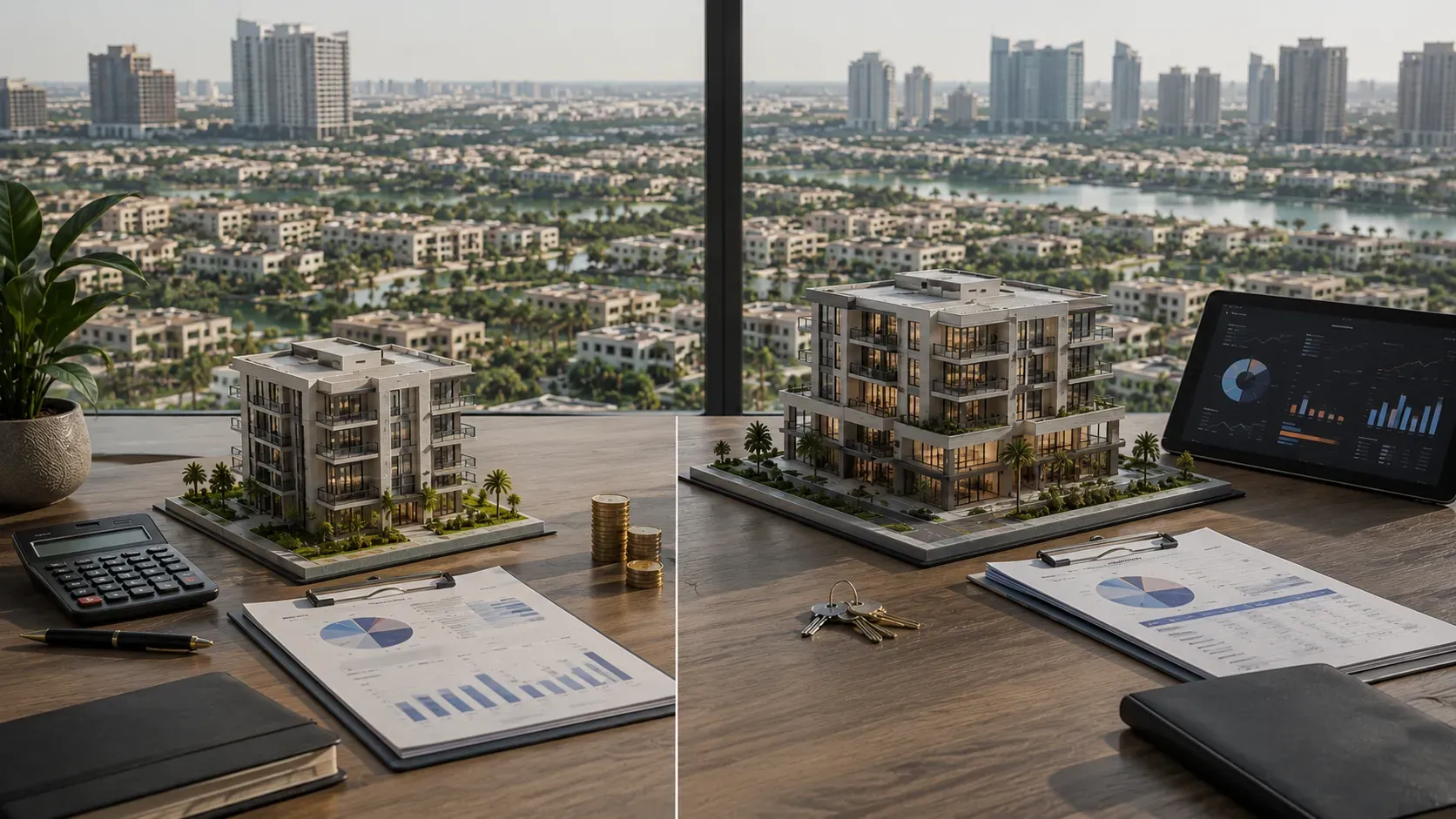
Buying your first investment property in Dubai is very different from buying your second.
With the first property, the main challenge is usually understanding the market, choosing an affordable asset and establishing whether property investment fits your financial goals. By the time you consider a second property, the focus should shift toward portfolio diversification, cash flow, financing capacity and risk management.
Dubai's property market remains highly active. According to Dubai Land Department, total real estate transactions reached AED 252 billion in Q1 2026, up 31% year on year. Real estate investments accounted for AED 173 billion across 57,744 investments.
Rental activity is also substantial. DLD reported AED 32.2 billion in rental contract value during Q1 2026, showing the scale of the city's rental market.
But strong market activity does not mean investors should automatically buy a second property. The second purchase needs to make sense within the context of the first.
First Investment Property vs Second Investment Property in Dubai
The biggest difference is simple:
Your first property starts your investment journey. Your second property starts building your portfolio.
When buying your first property, you are primarily trying to answer questions such as:
- Can I afford this property?
- Is the location suitable?
- Will it attract tenants?
- What rental income can I realistically expect?
- How much financing do I need?
- What are the associated costs?
- Is property investment suitable for my financial situation?
With the second property, you should ask additional questions:
- Does this property diversify my portfolio?
- Does it improve my overall cash flow?
- Am I taking on too much debt?
- Should I choose a different location?
- Should I buy a different property type?
- How will two properties perform if one becomes vacant?
- Can I comfortably manage both properties?
This shift from individual property analysis to portfolio analysis is one of the most important differences between the first and second investment.
What Is Different About Buying Your First Investment Property?
Your first investment property usually involves a significant learning curve.
You need to understand how Dubai's property market works and become familiar with:
- Purchase prices
- Rental demand
- Service charges
- Transaction costs
- Financing
- Property management
- Tenant demand
- Property registration
- Resale considerations
The first property also establishes your financial baseline.
For example, you learn how much rent you actually receive, how much you spend on maintenance and service charges and how long it takes to find a tenant.
Those real-world numbers become valuable when considering your second purchase.
Your first property should therefore be selected not only for its potential return but also for how comfortably you can own and manage it.
What Changes When Buying a Second Investment Property?
The second purchase introduces a new consideration: how the properties work together.
Imagine your first property is a one-bedroom apartment aimed at young professionals.
Buying another identical one-bedroom apartment in the same building may increase your rental income, but it also increases your exposure to the same:
- Building
- Location
- Tenant segment
- Service charges
- Supply conditions
- Property management
Instead, you might consider whether the second property should target a different tenant group or location.
For example, your second property could be a larger apartment or townhouse aimed at families.
That does not automatically make it a better investment, but it may create greater diversification.
The objective is not simply:
Property 1 + Property 2
It is:
Property 1 + Property 2 = a stronger overall portfolio
How Much Money Do You Need for a Second Investment Property?
The amount required depends on the property price, financing structure and applicable transaction costs.
However, the second purchase may require more careful financial planning because you already have an existing property and potentially an existing mortgage.
Before purchasing, calculate:
- Available savings
- Existing mortgage balance
- Current monthly mortgage payment
- Expected rental income
- Existing property expenses
- New down payment
- Purchase-related costs
- New mortgage payment
- Emergency reserves
- Expected net rental income
Do not assume that the equity in your first property is the same as freely available cash.
Your second purchase should leave you with enough liquidity to handle unexpected expenses.
A portfolio that looks profitable on paper can become uncomfortable if an investor has no cash available when a property becomes vacant or requires major repairs.
First vs Second Property: How Mortgage Financing Changes
Financing is one of the biggest differences between the first and second investment property.
The UAE Central Bank's mortgage regulations distinguish between different types of property purchases and borrowers. Loan-to-value limits depend on factors such as whether the property is an initial home, a subsequent property or an off-plan purchase.
For investment properties, lenders also need to account for the possibility of periods without rental income. The Central Bank's responsible financing rules state that lenders should deduct at least two months of rental income when calculating debt burden for an investment property, reflecting potential non-rental periods.
This is important because investors should not calculate affordability using the assumption that a property will generate rent every month without interruption.
Before taking a second mortgage, consider whether you could still meet both obligations if the second property remained vacant temporarily.
The question should not be:
"How much will the bank lend me?"
Instead, ask:
"How much debt can I comfortably manage?"
Should Your Second Investment Property Be Different From the First?
It can be, but it does not have to be.
The right decision depends on your investment strategy.
If your first apartment has performed exceptionally well and you understand that market segment, buying another similar property could make sense.
However, investors should recognise the concentration risk.
For example, owning three apartments in the same community means all three could potentially be affected by:
- Local oversupply
- Falling tenant demand
- Changes in service charges
- New competing developments
- Local infrastructure changes
- Changes in resale demand
A second property can therefore be an opportunity to introduce a different source of demand.
Possible diversification could involve:
- Different location
- Different property size
- Different tenant segment
- Different property type
- Different investment objective
The goal is not to make the properties completely unrelated. The goal is to avoid unnecessary concentration.
How Rental Income Affects Your Second Property Purchase
Your first property's rental performance should be one of the most important inputs when evaluating a second purchase.
Look at the actual performance rather than the original projection.
Ask:
- What rent did I actually achieve?
- How long was the property vacant?
- What were the annual service charges?
- How much did maintenance cost?
- Did I use a property manager?
- What was the net cash flow?
- How stable was tenant demand?
DLD's Rental Index provides a way to check average rental information and calculate applicable rental increases based on property and location information.
This can be useful when comparing the performance of an existing property with a potential second investment.
For example, if your first property generates a strong net return but requires considerable management, you may want the second property to be easier to manage.
If your first property produces strong capital growth but relatively weak rental income, you may instead look for a second property with stronger cash-flow characteristics.
First Property vs Second Property: How Risk Changes
Owning one investment property creates one major concentration point.
If that property becomes vacant, your rental income from property investment may temporarily fall to zero.
With two properties, the situation can be different.
If one becomes vacant while the other remains occupied, you may still receive income from the second property.
This is one potential advantage of diversification.
However, owning two properties also introduces additional obligations.
You now have:
- Two properties to maintain
- Potentially two mortgages
- Two sets of service charges
- More tenant management
- More exposure to market fluctuations
- Greater capital requirements
So the second property can reduce some types of risk while increasing others.
This is why simply owning more properties does not automatically mean lower risk.
How to Choose the Right Location for Your Second Investment Property
Your second property is an opportunity to examine whether your portfolio is overly concentrated in one area.
Start by analysing your first property's location.
Consider:
- Tenant demand
- Rental performance
- Supply
- Resale demand
- Accessibility
- Nearby amenities
- Service charges
- Future developments
Then compare those characteristics with potential second-property locations.
DLD provides official real estate data covering transaction and rental information, which can be useful when researching different areas and property types.
Rather than choosing a location simply because it is popular, determine what role the new property should play.
For example:
First property: Rental-focused apartment
Second property: Family-oriented townhouse
This may provide greater diversification than purchasing another almost identical apartment.
Should You Buy the Same Property Type Twice?
There is no universal answer.
Buying the same property type can make management easier.
If you already understand a particular apartment segment, acquiring another unit in that segment may reduce your learning curve.
You may already know:
- Typical tenant profiles
- Rental ranges
- Maintenance requirements
- Building management
- Service charges
- Resale demand
However, there is a trade-off.
Two similar properties may produce similar returns, but they may also face similar risks.
Diversifying into another property type can spread exposure but may also introduce a new management and market environment.
The decision should therefore be based on your portfolio objectives rather than diversification for its own sake.
When Is the Right Time to Buy a Second Investment Property?
There is no fixed waiting period.
Instead, consider whether your first investment is stable.
You may be better positioned for a second purchase when:
- The first property has a reliable tenant
- You understand its actual expenses
- Your mortgage payments are comfortable
- You have rebuilt your cash reserves
- You have sufficient funds for the second purchase
- You understand your expected net return
- You have identified a clear reason for buying the second property
You may want to wait if:
- Your first property is struggling to generate income
- Your emergency savings are too low
- Your existing debt is already uncomfortable
- You are relying heavily on projected rental income
- You have not researched the second property properly
There is no benefit in rushing into a second purchase simply because the market is active.
How to Compare Your First and Second Investment Properties
Do not evaluate the second property in isolation.
Compare both properties using the same framework.
Factor | First Property | Second Property |
|---|---|---|
Purchase price | Actual cost | Expected cost |
Rental income | Actual rent | Expected rent |
Net yield | Actual performance | Estimated performance |
Mortgage | Existing obligation | New obligation |
Service charges | Actual cost | Estimated cost |
Tenant demand | Observed | Researched |
Location | Current exposure | Diversification opportunity |
Property type | Existing exposure | Portfolio fit |
Vacancy risk | Historical | Estimated |
Exit strategy | Existing plan | New strategy |
This comparison can reveal whether the second property actually strengthens the portfolio.
For example, if both properties have similar prices, rents and risks, buying the second may simply double your exposure without adding much diversification.
Common Mistakes When Buying a Second Investment Property in Dubai
Assuming the Second Property Will Perform Like the First
Every property has different characteristics.
Using All Available Equity
Having equity does not mean you should use all of it.
Ignoring Existing Debt
The second mortgage should be evaluated alongside the first.
Buying in the Same Area Without Considering Concentration
Similar properties can create unnecessary exposure to one market.
Focusing Only on Gross Rental Yield
Expenses can substantially change the actual return.
Buying Too Quickly
A second purchase should be based on analysis rather than excitement about portfolio growth.
Assuming Rental Income Is Guaranteed
Vacancies and changing market conditions need to be considered.
Forgetting Management Capacity
Two properties require more management than one.
Buying Without an Exit Strategy
Think about how and when you might eventually sell the property.
First vs Second Investment Property Checklist
Before purchasing your second investment property, ask:
Question | First Property | Second Property |
|---|---|---|
What is the investment goal? | Establish strategy | Strengthen portfolio |
Can I afford the purchase? | Establish affordability | Consider existing obligations |
What is the expected rent? | Estimate | Compare with actual first-property rent |
What are the expenses? | Estimate | Use first property's experience |
Is financing required? | Assess initial borrowing | Assess total portfolio debt |
Is the location suitable? | Evaluate independently | Consider diversification |
Is the property type suitable? | Establish first exposure | Consider portfolio balance |
What is the vacancy risk? | Estimate | Consider combined cash flow |
What happens if the market weakens? | Assess individual property | Assess entire portfolio |
Does the purchase improve my portfolio? | Start portfolio | Strengthen portfolio |
Frequently Asked Questions
Is the second investment property harder to buy than the first?
It can be financially more complex because your existing property, mortgage and expenses need to be considered alongside the new purchase.
Should my second property be in a different area?
Not necessarily. However, buying in a different area can reduce concentration risk if your first property already represents significant exposure to one location.
Is it better to buy the same property type twice?
It depends on your strategy. Buying the same property type can simplify management, while buying a different type can provide greater diversification.
Should I use rental income from my first property to finance the second?
Rental income may contribute to your overall financial position, but you should not assume it will remain constant. Lenders also account for potential non-rental periods when assessing investment-property financing.
How long should I wait before buying a second investment property?
There is no universal waiting period. Consider buying when your first property is stable, your finances are comfortable and you have sufficient reserves for another acquisition.
Is owning two properties safer than owning one?
Not necessarily. Two properties can diversify rental income, but they also create additional debt, expenses and management responsibilities.
How should I compare my first and second investment properties?
Compare purchase price, net rental income, expenses, financing, location, tenant demand, vacancy risk, potential capital growth and exit strategy.
Should I buy an off-plan property as my second investment?
It can be considered, but off-plan properties have different risks, timelines and financing considerations. Investigate the developer, project, payment structure and expected completion carefully before investing.
Final Thoughts
The difference between a first investment property and a second investment property in Dubai is not simply the number of properties you own.
Your first purchase establishes your investment foundation. Your second purchase should begin to answer a bigger question:
What kind of portfolio do I want to build?
The first property may teach you about rental demand, expenses, financing and property management. The second gives you an opportunity to use that experience to make a more strategic decision.
Dubai's market continues to attract substantial investment, with DLD reporting AED 252 billion in total real estate transactions during Q1 2026 and AED 173 billion in real estate investments. The rental market is also active, with AED 32.2 billion in rental contract value recorded during the quarter.
But market strength should not be a reason to overextend yourself.
Before buying your second property, review your first property's actual rental income, expenses, financing, vacancy experience and overall performance. Then ask what the second property adds.
It could provide stronger rental income, geographic diversification, a different tenant segment or greater exposure to another part of Dubai's property market.
The best second property is not necessarily the cheapest, largest or highest-yielding property. It is the one that fits your finances and strengthens the portfolio you are already building.
For more Dubai property investment guides, buying advice and real estate insights, visit Buy Home Dubai.

Dubai Real Estate
Ready to find your
dream home in Dubai?
Browse thousands of properties across Dubai's most sought-after neighbourhoods. Our experts are ready to guide you.