Real EstateAugust 28, 2026
How to Build a Dubai Property Portfolio
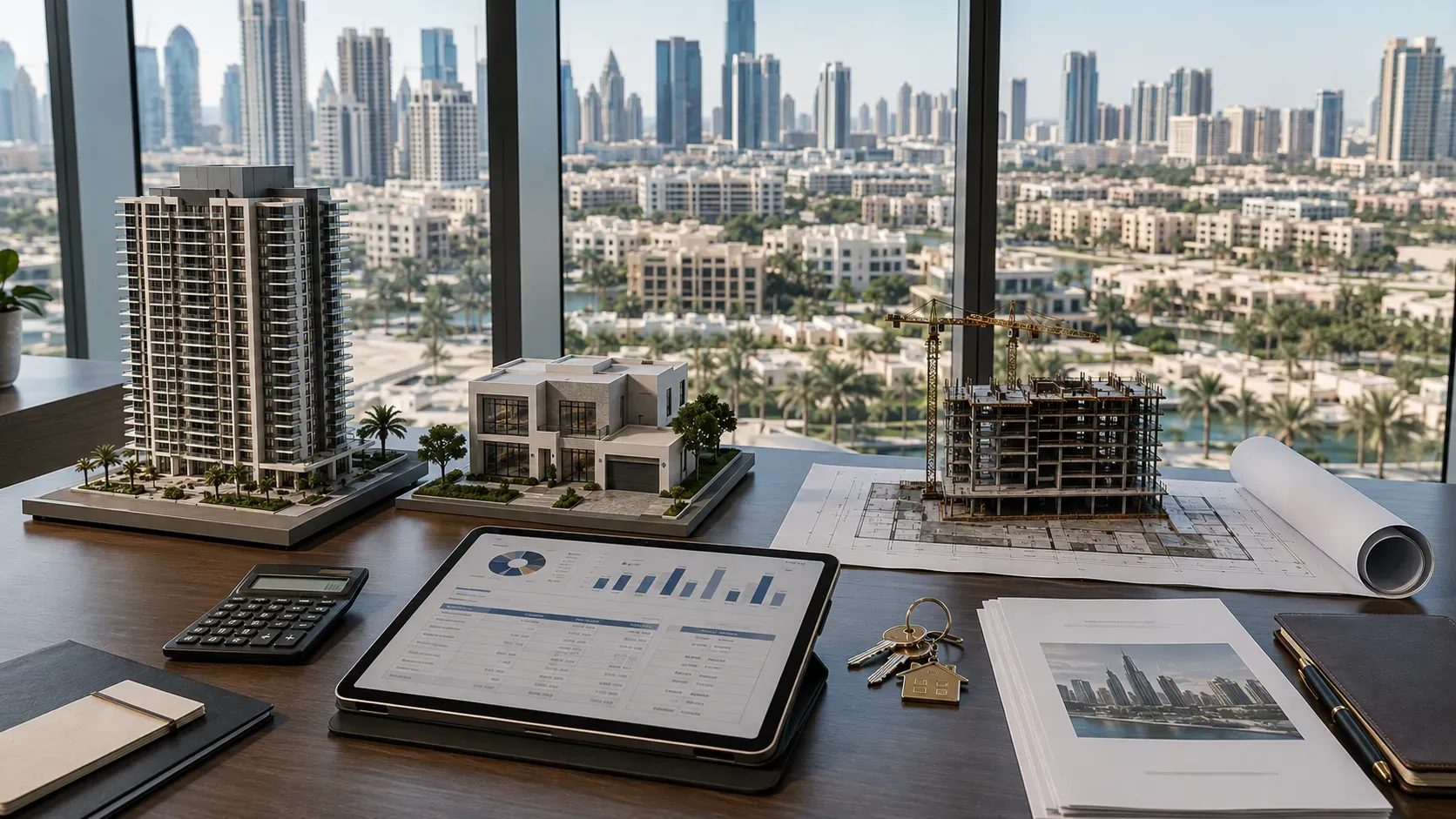
Building a Dubai property portfolio is not simply about buying several properties and waiting for their values to increase. A successful portfolio requires a clear investment strategy, careful property selection, sensible financing, rental analysis and ongoing risk management.
Dubai continues to attract substantial real estate investment. Dubai Land Department reported AED 252 billion in total real estate transactions in Q1 2026, up 31% year on year, while real estate investments reached AED 173 billion across 57,744 investments. The number of investors also increased to 48,448, including 29,312 new investors.
Rental activity also remains significant. DLD reported AED 32.2 billion in rental contract value during Q1 2026, with 118,385 new contracts and 135,607 renewals.
These figures show why Dubai remains an important market for property investors. However, strong market activity does not mean every property is a good investment. Building a portfolio means choosing assets that work together rather than simply accumulating properties.
Why Build a Property Portfolio in Dubai?
A property portfolio can provide several potential benefits when it is properly structured.
The first is income diversification. Instead of relying on one rental property, an investor can generate rental income from several units.
The second is capital diversification. Different properties may perform differently depending on location, property type and market conditions.
A portfolio can also provide exposure to different segments of Dubai's real estate market, including:
- Apartments
- Villas
- Townhouses
- Off-plan properties
- Completed rental properties
- Premium properties
- Commercial units
Dubai's rental market has demonstrated substantial activity. During 2025, registered tenancy contracts reached 1.38 million with a total value of AED 126.4 billion, according to DLD.
However, investors should remember that rental income, capital appreciation and occupancy are never guaranteed.
The objective should be to create a portfolio where individual properties serve different purposes.
How Much Money Do You Need to Build a Dubai Property Portfolio?
There is no fixed amount required to build a Dubai property portfolio.
A portfolio can begin with one property and grow gradually.
For example, an investor might start with:
Property 1: A reasonably priced apartment focused on rental income.
Property 2: A property in a different location with stronger long-term growth potential.
Property 3: A larger townhouse or villa aimed at a different tenant or buyer segment.
The important point is not how quickly you acquire properties. It is whether each additional purchase improves the overall portfolio.
Before buying your first property, calculate:
- Available capital
- Down payment
- Transaction costs
- Mortgage payments
- Expected rent
- Service charges
- Maintenance costs
- Vacancy allowance
- Property management costs
- Emergency reserves
Do not use every available dirham for the down payment.
A portfolio with no cash reserves can become vulnerable when a property is vacant, maintenance costs increase or financing becomes more expensive.
How to Set Property Investment Goals in Dubai
Your investment objective should determine what you buy.
Some investors primarily want monthly rental income.
Others focus on long-term capital growth.
Some want a combination of both.
Before purchasing, decide whether your main goal is:
Rental Income
You may prioritise properties with strong tenant demand and attractive rental economics.
Capital Growth
You may accept lower initial rental returns in exchange for exposure to locations or properties with stronger long-term growth potential.
Balanced Returns
You can combine income-producing properties with assets selected for potential appreciation.
Portfolio Diversification
You may deliberately purchase different property types or target different tenant groups.
A portfolio becomes easier to manage when every property has a clearly defined role.
How to Choose the Right Dubai Property Investment Strategy
There is no single strategy that works for every investor.
Buy and Hold
The investor purchases a property and holds it for several years while generating rental income and potentially benefiting from capital appreciation.
This is relatively straightforward but requires patience and ongoing management.
Rental Income Strategy
The primary objective is to generate recurring rental income.
The investor should pay particular attention to:
- Rental demand
- Achievable rent
- Service charges
- Vacancy
- Maintenance
- Property management
- Financing costs
Capital Growth Strategy
The investor focuses more heavily on the property's potential long-term value.
Location, infrastructure, community development, supply and demand and property quality become particularly important.
Hybrid Strategy
Many investors may prefer a combination of income and growth-oriented properties.
For example, one property could focus on rental income while another targets long-term capital appreciation.
Which Dubai Areas Are Best for a Property Portfolio?
There is no universally "best" area for every investor.
The right location depends on the property's price, rental demand, tenant profile, supply, accessibility and investment objective.
Instead of choosing an area purely because it is popular, compare locations using measurable factors.
Consider:
- Average purchase price
- Rental levels
- Rental demand
- Vacancy
- Service charges
- New supply
- Transport accessibility
- Nearby employment centres
- Schools and amenities
- Community development
- Resale demand
DLD's Rental Index can be used to calculate average rental information and applicable rental increases based on property and location information.
This is particularly useful when evaluating an income-focused investment.
Rather than asking, "Which Dubai area is best?", ask:
Which location best fits the role this property will play in my portfolio?
Should You Diversify Across Different Dubai Property Types?
Diversification can reduce your dependence on a single property segment.
For example, an investor with three identical apartments in the same building is exposed to the same:
- Building management
- Service charges
- Tenant market
- Local supply
- Maintenance conditions
- Resale environment
A more diversified portfolio might contain different property types.
For example:
Property | Primary Objective |
|---|---|
Apartment | Rental income |
Townhouse | Family rental demand |
Premium apartment | Capital growth and higher-value rental |
Off-plan unit | Long-term growth potential |
However, diversification should not mean buying random properties.
Each property should have a clear investment purpose.
Too much diversification can also make a portfolio difficult to manage, particularly for smaller investors.
How to Balance Rental Income and Capital Growth
One of the most important decisions when building a Dubai property portfolio is balancing cash flow and capital growth.
A property with a high purchase price may offer attractive long-term potential but produce relatively lower rental returns.
Another property may offer stronger rental economics but have less potential for capital appreciation.
Investors should therefore examine both.
A basic rental yield calculation is:
Gross Rental Yield = Annual Rental Income ÷ Property Purchase Price × 100
For example, if a property costs AED 1 million and generates AED 60,000 in annual rent, the gross rental yield is 6%.
But gross yield is not the same as actual investment return.
You also need to consider:
- Service charges
- Maintenance
- Insurance
- Property management
- Vacancy
- Financing costs
- Transaction expenses
This gives you a more realistic picture of the property's cash flow.
Should Your Dubai Property Portfolio Include Off-Plan Properties?
Off-plan property can form part of a portfolio, but it should not automatically be treated as a better investment.
Potential advantages include:
- Developer payment plans
- Lower initial capital requirements in some cases
- Exposure to new communities
- Potential capital appreciation
- Modern layouts and facilities
However, there are also risks.
These can include:
- Construction delays
- Market changes before completion
- Future supply
- Changes in rental demand
- Developer risk
- Final property specifications
- Financing requirements at handover
If you are considering an off-plan investment, investigate the developer, project registration, payment structure, escrow arrangements and expected completion carefully.
DLD provides services and information relating to registered projects and project completion status, making official verification an important part of due diligence.
Read How to Choose the Right Property Developer before committing to an off-plan purchase.
How to Finance Multiple Properties in Dubai
Financing can help investors grow a portfolio without using all their capital for each purchase.
However, leverage also increases risk.
Before taking another mortgage, calculate the impact of:
- Monthly mortgage payments
- Interest or profit rates
- Down payment
- Rental income
- Vacancy
- Service charges
- Maintenance
- Existing debt
- Emergency reserves
Do not assume that rental income will always cover your financing costs.
A property can remain vacant, require major maintenance or experience a period of lower rental demand.
Investors should also consider how another mortgage affects their ability to purchase future properties.
A portfolio should grow sustainably rather than simply becoming more leveraged.
How to Calculate Rental Yield and Investment Returns
Rental yield is one of the first numbers investors should calculate, but it should not be the only one.
Consider three levels of analysis.
Gross Rental Yield
This compares annual rent with the property's purchase price.
Net Rental Yield
This accounts for expenses such as:
- Service charges
- Maintenance
- Management fees
- Vacancy
- Other operating costs
Total Return
This can include both rental income and changes in property value.
A property with a lower rental yield may still make sense if it serves another strategic purpose in your portfolio.
Similarly, a high advertised yield does not necessarily mean a property is a better investment.
Always investigate how the advertised figure was calculated.
How to Manage Risk in a Dubai Property Portfolio
Risk management becomes increasingly important as your portfolio grows.
Avoid Concentration Risk
Owning five properties in one building creates more concentration than owning properties across different locations.
Maintain Cash Reserves
Keep sufficient liquidity for:
- Vacancies
- Repairs
- Mortgage payments
- Service charges
- Unexpected expenses
Avoid Excessive Debt
High leverage can increase returns when conditions are favourable but can also magnify losses and cash-flow problems.
Research New Supply
A large amount of new inventory entering a specific area can affect rental competition and resale demand.
Monitor Rental Performance
Do not assume that a property will continue producing the same rent forever.
Use available market information, including DLD's Rental Index, when reviewing rental conditions.
Review Your Portfolio Regularly
A property that made sense five years ago may not necessarily be the best asset to hold indefinitely.
How to Scale From One Property to Multiple Properties
A common mistake is trying to build a portfolio too quickly.
A more controlled approach is:
Step 1: Buy the First Property
Choose a property that fits your finances and investment objective.
Step 2: Stabilise It
Rent the property, monitor expenses and understand its actual cash flow.
Step 3: Build Reserves
Maintain an emergency fund before considering another purchase.
Step 4: Review the First Investment
Determine whether the property is meeting expectations.
Step 5: Identify the Portfolio Gap
Ask what the second property should add.
For example, if the first property is an apartment aimed at young professionals, the second property could target families.
Step 6: Buy the Second Property
Only proceed when the acquisition makes sense financially and strategically.
Step 7: Repeat the Process
Each additional property should improve diversification, income or growth potential.
This approach is generally more sustainable than buying multiple properties simply because financing is available.
How to Manage and Review Your Dubai Property Portfolio
Portfolio management should continue after the purchase.
Create a simple record for every property containing:
- Purchase price
- Purchase date
- Financing
- Monthly mortgage
- Annual rent
- Service charges
- Maintenance
- Management fees
- Vacancy
- Current estimated value
- Net cash flow
- Outstanding loan balance
Review these figures periodically.
You can then identify which properties are:
- Producing strong cash flow
- Underperforming
- Increasing in value
- Becoming expensive to maintain
- Exposed to excessive supply
- Suitable for long-term holding
- Potential candidates for sale
A portfolio should be actively managed rather than left untouched for years.
Common Mistakes When Building a Dubai Property Portfolio
Buying Only Because Prices Are Rising
Past performance does not guarantee future appreciation.
Focusing Only on Gross Yield
A high gross yield can look attractive until service charges, maintenance and vacancy are included.
Buying Too Many Similar Properties
Concentration can increase portfolio risk.
Using Too Much Debt
Leverage can become problematic if rental income falls or financing costs increase.
Ignoring Service Charges
Service charges can significantly affect the net return of apartments and other managed properties.
Choosing an Area Without Research
Popularity alone does not determine investment performance.
Buying Without an Exit Strategy
Before buying, consider how easily you could eventually sell the property.
Ignoring New Supply
Future developments can influence rental competition and resale demand.
Treating Off-Plan Property as Risk-Free
Off-plan investments have their own set of risks and should be evaluated carefully.
Expanding Too Quickly
A larger portfolio is not necessarily a better portfolio.
Dubai Property Portfolio Checklist
Before buying another property, ask:
Question | Why It Matters |
|---|---|
What is my investment objective? | Defines the property's role |
What is the expected rental income? | Helps estimate cash flow |
What are the total expenses? | Determines net return |
Is the location diversified? | Reduces concentration |
Is the property type diversified? | Reduces segment risk |
How much debt will I take? | Controls financial risk |
Do I have emergency reserves? | Protects against unexpected costs |
What future supply is planned? | Helps assess competition |
Is the developer reliable? | Important for off-plan purchases |
What is my exit strategy? | Supports long-term planning |
How will I manage the property? | Protects operational performance |
Frequently Asked Questions About Building a Dubai Property Portfolio
How do I start a property portfolio in Dubai?
Start with a property that fits your budget and investment objective. Focus on understanding its actual rental performance and expenses before purchasing additional properties.
How many properties should I own?
There is no ideal number. The right number depends on your capital, financing capacity, cash flow, risk tolerance and ability to manage the properties.
Is Dubai property good for rental income?
Dubai has a substantial rental market. DLD reported AED 32.2 billion in rental contract value during Q1 2026, alongside more than 118,000 new rental contracts. However, rental income varies by property and location and is not guaranteed.
Should I buy apartments or villas for my Dubai portfolio?
Both can have a role. Apartments may suit investors targeting particular rental segments, while villas and townhouses may appeal to family-oriented demand. The decision should be based on price, rental economics, supply and your portfolio strategy.
Should I diversify my Dubai property portfolio?
Diversification can reduce concentration risk. However, diversification should be strategic rather than simply buying unrelated properties.
Should I include off-plan properties?
Off-plan properties can be part of a diversified portfolio, but investors should carefully evaluate the developer, project, payment plan, completion risk and future supply.
How can I check Dubai rental information?
DLD's Rental Index provides information that can help users calculate average rental information and applicable rental increases based on property and location details.
Is it better to buy several cheap properties or one expensive property?
Neither approach is automatically better. Several lower-priced properties may provide diversification, while a single premium property may offer a different combination of rental demand and capital-growth potential.
How often should I review my property portfolio?
A regular review is sensible. At minimum, track rental income, expenses, financing, property values and market conditions so you can identify underperforming assets and changing risks.
Final Thoughts
Building a Dubai property portfolio should be treated as a long-term investment strategy rather than a race to accumulate as many properties as possible.
Dubai's real estate market continues to attract significant investment. DLD recorded AED 252 billion in total real estate transactions during Q1 2026, with AED 173 billion attributed to real estate investments. The rental market is also active, with AED 32.2 billion in rental contract value recorded during the same quarter.
But strong market activity does not remove investment risk.
The strongest portfolio strategy is usually built around clear objectives, sensible financing, property diversification, realistic rental calculations, cash reserves and regular performance reviews.
Start with one well-researched property. Understand how it performs. Then identify what your portfolio is missing before making the next purchase.
Over time, this approach can help you build a more balanced portfolio rather than simply collecting properties.
For more Dubai real estate guides, buying advice and property investment insights, visit Buy Home Dubai.

Dubai Real Estate
Ready to find your
dream home in Dubai?
Browse thousands of properties across Dubai's most sought-after neighbourhoods. Our experts are ready to guide you.