Real EstateAugust 7, 2026
How Inflation Affects Dubai Property Prices
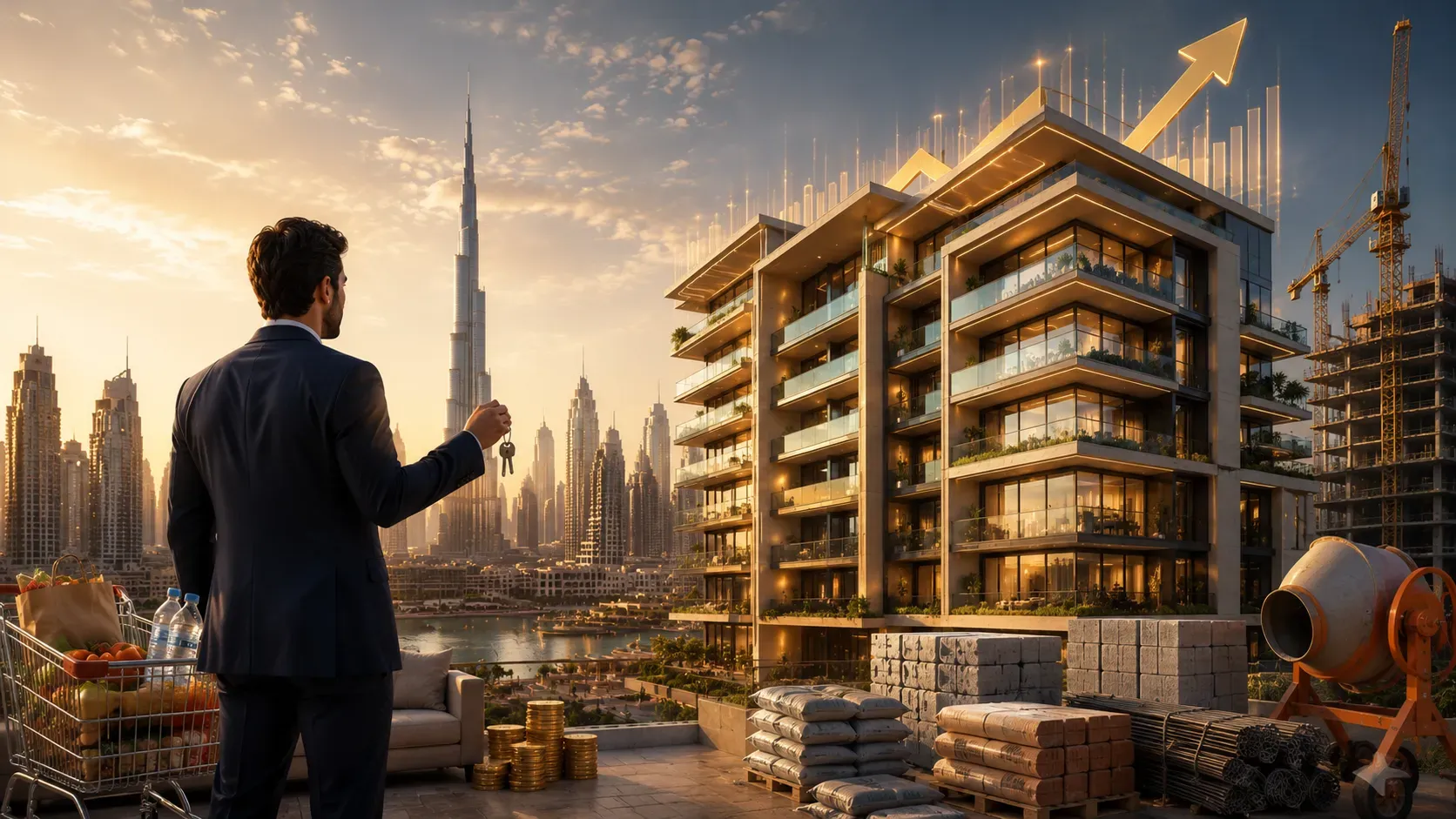
Inflation affects almost every part of the economy, including housing costs, rents, construction expenses, borrowing costs, and property investment decisions. For Dubai property buyers and investors, understanding this relationship can help put changes in property prices into context.
Inflation does not automatically mean that property prices will rise. Real estate prices are influenced by several factors at the same time, including supply and demand, population growth, interest rates, construction costs, investor confidence, and economic activity.
Dubai's recent market performance illustrates why these factors need to be considered together. Dubai inflation reached 5.5% in May 2026, while the property market remained resilient, with housing sales and rents continuing to hold firm.
Earlier market data also showed strong property growth. Deloitte reported that Dubai residential sales prices increased by 20% in 2024, while rents increased by 19%, demonstrating that property and rental markets can move significantly during periods of changing costs and strong demand.
This guide explains how inflation can affect Dubai property prices, rental income, construction costs, mortgages, and investment decisions.
Quick Answer
Inflation can put upward pressure on Dubai property prices by increasing construction and operating costs and encouraging some investors to seek tangible assets. However, inflation alone does not determine property prices. Demand, supply, interest rates, population growth, and economic conditions can have an equally important or greater influence.
Key Takeaways
- Inflation increases the cost of goods and services across the economy.
- Higher construction costs can put upward pressure on new property prices.
- Rental prices can increase when housing demand remains strong.
- Higher interest rates can make mortgages more expensive.
- Inflation does not guarantee property appreciation.
- Supply and demand remain critical factors in Dubai's property market.
- Investors should consider real returns rather than looking only at nominal price growth.
What Is Inflation?
Inflation is the sustained increase in the general price level of goods and services over time.
When inflation rises, the purchasing power of money generally falls. The same amount of money may buy fewer goods and services than it did previously.
For property investors, inflation can affect several parts of the investment equation, including:
- Property purchase prices
- Construction costs
- Rental prices
- Maintenance expenses
- Mortgage costs
- Property management expenses
The impact on each of these areas can be different.
How Inflation Can Affect Property Prices
Inflation can influence property prices through several channels.
When the cost of construction materials, labour, transportation, and other inputs increases, developers may face higher costs when building new properties.
If developers pass some of these higher costs to buyers, new properties can become more expensive.
At the same time, property prices depend on whether buyers are willing and able to pay those higher prices.
This means inflation can create upward cost pressure, but actual property price growth still depends on market demand and available supply.
Inflation and Construction Costs
Construction is one of the most direct ways inflation can affect real estate.
Higher prices for:
- Building materials
- Labour
- Fuel
- Transportation
- Equipment
- Utilities
can increase the cost of developing residential and commercial properties.
If development costs rise significantly, new properties may need to be sold at higher prices for projects to remain financially viable.
However, higher construction costs do not automatically increase the value of every existing property. Market demand remains an important factor.
Inflation and Rental Prices
Inflation can also affect the rental market.
As the cost of living increases, landlords may face higher expenses for maintenance, repairs, property management, and other services.
Rental prices can rise when strong tenant demand allows landlords to increase rents.
Dubai's rental market remained particularly strong in 2025. According to Dubai Land Department data, registered tenancy contracts increased by 6% in volume and 17% in value compared with 2024, reaching 1.38 million contracts worth AED 126.4 billion.
However, rental growth is not determined by inflation alone. New housing supply can increase tenant choice and reduce upward pressure on rents.
Inflation and Property Demand
Inflation can influence how people allocate their money.
Some investors may prefer tangible assets such as real estate when they are concerned about declining purchasing power.
This can support property demand, particularly when the economy is growing and investor confidence remains strong.
However, higher inflation can also reduce consumers' disposable income and increase household expenses.
Therefore, inflation can create both positive and negative effects for property demand.
Inflation and Mortgage Costs
Mortgage costs are another important consideration.
When inflation becomes persistent, central banks may use interest-rate policy to manage price pressures. Higher borrowing costs can make mortgages more expensive and reduce the amount some buyers can afford.
The UAE's monetary framework is closely connected to the US dollar because the dirham is maintained at a fixed exchange rate against the US dollar. The Central Bank of the UAE explains that maintaining this exchange-rate regime influences the country's monetary framework.
For property investors using financing, changes in borrowing costs can therefore be just as important as changes in property prices.
Inflation Does Not Always Mean Higher Property Prices
It is a mistake to assume that property prices must rise whenever inflation increases.
For example, if inflation increases while mortgage rates rise sharply and buyer affordability declines, property demand could weaken.
Similarly, if a large amount of new housing enters the market, additional supply could limit price growth even when general prices are rising.
Dubai's current market demonstrates the importance of looking beyond inflation alone. Property prices have continued to rise while price growth has moderated as supply catches up with strong demand.
Nominal vs Real Property Returns
Another important concept for investors is the difference between nominal returns and real returns.
Suppose a property increases in value by 8% over a year while inflation is 4%.
The property's nominal appreciation is 8%, but its inflation-adjusted return is lower.
This matters because investors ultimately care about changes in purchasing power, not just the number shown on a property valuation.
Inflation vs Property Appreciation
Inflation and property appreciation are related, but they are not the same thing.
Inflation measures the general increase in prices across an economy, while property appreciation measures the increase in the market value of a specific property.
A property may appreciate faster than inflation, slower than inflation, or even decline in value during a period of rising inflation.
Several factors determine the difference, including:
- Location
- Supply and demand
- Rental demand
- Infrastructure development
- Interest rates
- Population growth
- Economic conditions
- Property quality
For a deeper explanation of the factors that can influence future value growth, see our guide on How to Estimate Property Appreciation.
How Investors Can Respond to Inflation
Investors should focus on the overall economics of a property rather than assuming inflation automatically creates an opportunity.
Focus on Rental Income
A property with strong and sustainable rental demand may provide income that can partially offset rising ownership costs.
However, investors should calculate net rental yield, rather than relying only on advertised rental income.
Consider Long-Term Demand
Properties in areas with strong employment, transport connections, amenities, and population growth may have better long-term demand.
Strong underlying demand can be more important than short-term inflation movements.
Evaluate Financing Carefully
Investors using mortgages should consider how borrowing costs affect monthly cash flow.
A property with attractive rental income may become less attractive if financing costs significantly reduce the investor's net return.
Monitor Operating Costs
Inflation can increase maintenance, repairs, management, and other ownership costs.
Investors should include realistic expense estimates when calculating expected returns.
Is Real Estate a Hedge Against Inflation?
Real estate is sometimes viewed as a potential inflation hedge because property values and rents can increase over time as the cost of goods, services, and construction rises.
However, this does not mean every property automatically protects an investor against inflation.
A property's performance depends on:
- Market demand
- Location
- Rental income
- Supply
- Financing costs
- Operating expenses
- Economic conditions
A well-located property with sustainable rental demand may be better positioned to maintain its value than a property in an oversupplied or weak-demand market.
Inflation and Dubai's Property Supply
Supply is particularly important when analysing Dubai property prices.
If demand grows faster than available housing, prices and rents can come under upward pressure.
If new supply grows faster than demand, competition between properties can increase and limit price growth.
Dubai's real estate market has experienced significant development activity, making future supply an important consideration for investors.
This means investors should look beyond current inflation figures and examine how much new residential inventory is expected in their chosen community.
Inflation and Different Property Types
Inflation can affect property types differently.
Apartments
Apartments may benefit from strong rental demand in areas close to employment centres, transport links, and amenities.
Villas
Villas can appeal to families seeking larger homes, but their maintenance costs may be higher.
Commercial Property
Commercial real estate can be influenced by business activity, leasing demand, economic growth, and contract structures.
Off-Plan Property
Off-plan investments can be affected by construction costs, completion timelines, financing conditions, and future market demand.
Therefore, investors should not assume that inflation will have the same effect across every segment of Dubai's property market.
Common Mistakes Investors Should Avoid
Assuming Inflation Guarantees Appreciation
Rising consumer prices do not guarantee that a particular property will increase in value.
Ignoring Interest Rates
Higher borrowing costs can reduce purchasing power and affect investment returns.
Looking Only at Purchase Prices
A property's purchase price is only one part of the investment calculation. Service charges, maintenance, financing, vacancy, and other costs also matter.
Ignoring Supply
Even strong demand may not translate into substantial price growth if large amounts of new housing become available.
Confusing Nominal and Real Returns
An increase in property value does not necessarily mean the investor has achieved an equivalent increase in purchasing power.
How Inflation Affects Property Investors
The effect of inflation depends largely on whether property income and value growth can keep pace with rising costs.
Consider a simplified example:
Item | Before Inflation | After Inflation |
|---|---|---|
Property value | AED 1,000,000 | AED 1,080,000 |
Annual rent | AED 70,000 | AED 75,000 |
Annual expenses | AED 15,000 | AED 18,000 |
Net rental income | AED 55,000 | AED 57,000 |
The property value and rental income increased, but expenses also increased.
This illustrates why investors should evaluate both income and costs rather than assuming inflation automatically improves investment returns.
Should You Buy Property During Inflation?
There is no universal answer.
Buying property during an inflationary period can make sense when the property has:
- Strong rental demand
- A suitable purchase price
- Healthy long-term fundamentals
- Manageable ownership costs
- Good location
- Sustainable financing
On the other hand, buying an overpriced property simply because prices are rising can increase investment risk.
The most important question is not whether inflation is high, but whether the individual property makes financial sense based on its expected income, costs, market value, and long-term potential.
Final Verdict
Inflation can influence Dubai property prices through construction costs, rental prices, operating expenses, borrowing costs, and changes in investor behaviour. However, inflation alone does not determine whether property values will rise.
Dubai's real estate market is influenced by a broader combination of supply and demand, population growth, infrastructure, economic activity, financing conditions, and investor confidence.
For property investors, the best approach is to look beyond headline price growth. Evaluate rental income, net yield, ownership costs, financing, future supply, and long-term appreciation potential before making a decision.
For buyers and investors looking to explore Dubai's property market, Buy Home Dubai can be a useful starting point for researching properties and evaluating opportunities based on location, budget, and investment goals.
Frequently Asked Questions
Does inflation increase property prices in Dubai?
Inflation can contribute to upward pressure on property prices through higher construction and operating costs, but it does not guarantee price increases. Supply, demand, interest rates, and economic conditions also play major roles.
Does inflation increase Dubai rents?
It can contribute to higher rents, particularly when landlords face rising costs and tenant demand remains strong. However, rental prices are primarily determined by market conditions, including supply and demand.
Is property a good hedge against inflation?
Real estate can potentially protect purchasing power over the long term, particularly when property values and rents rise with broader prices. However, performance varies by property and market conditions.
Can inflation reduce property investment returns?
Yes. Higher inflation can increase maintenance and operating costs and may contribute to higher borrowing costs. These factors can reduce an investor's net return.
Does inflation affect mortgage rates in Dubai?
Inflation can influence monetary policy and interest-rate conditions, which can affect borrowing costs. UAE interest-rate conditions are closely linked to the country's exchange-rate framework.
Should investors focus on property appreciation or rental income during inflation?
Both should be considered. Rental income provides ongoing cash flow, while appreciation can contribute to long-term wealth creation. Evaluating them together gives a more complete picture of potential investment performance.
What is the biggest risk of buying property during inflation?
One major risk is assuming that inflation automatically leads to property appreciation. If interest rates rise, affordability falls, or housing supply increases substantially, property returns may not keep pace with inflation.

Dubai Real Estate
Ready to find your
dream home in Dubai?
Browse thousands of properties across Dubai's most sought-after neighbourhoods. Our experts are ready to guide you.