Real EstateSeptember 8, 2026
What Are Smart Homes in Dubai? Features, Benefits & Investment Value
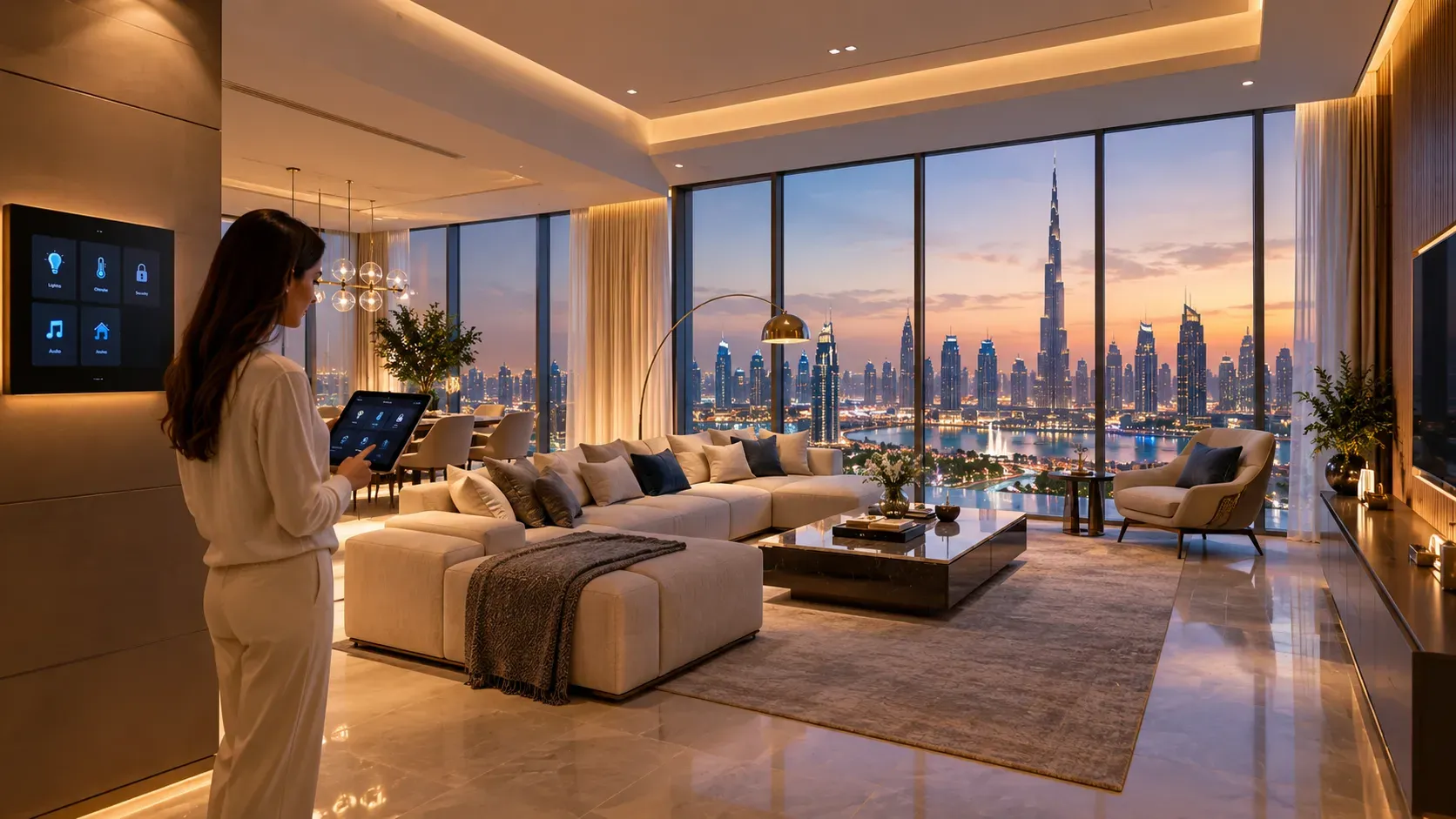
Technology is becoming an increasingly important part of modern residential property in Dubai. Alongside larger layouts, premium finishes and lifestyle amenities, buyers and tenants are paying more attention to homes that can automate lighting, cooling, security and other everyday functions.
These properties are commonly described as smart homes.
But a smart home is more than an apartment with a voice-controlled speaker or a few connected light bulbs. A properly integrated smart home allows multiple systems to communicate with each other and can give residents greater control over comfort, security, energy use and daily routines.
For Dubai property buyers, smart technology can also become part of the property's overall value proposition. However, buyers should understand which features provide genuine practical benefits and which are mainly marketing additions.
Quick Answer
A smart home in Dubai is a property equipped with connected technology that allows systems such as lighting, air conditioning, security, curtains, locks and energy monitoring to be controlled automatically or remotely.
Common features include smart lighting, climate control, automated curtains, CCTV, smart locks, video intercoms, energy monitoring, water-leak detection and centralised home automation.
Smart homes can offer greater convenience, security and energy efficiency. They may also improve rental and resale appeal, particularly in premium segments. However, smart technology does not automatically guarantee a higher property value or rental yield.
What Is a Smart Home in Dubai?
A smart home uses connected devices, sensors and control systems to automate or remotely manage different parts of a residence.
Instead of operating each system separately, residents can control several functions through a mobile application, voice assistant, wall panel or central home-automation system.
For example, a resident could create an "Away" setting that:
- Turns off selected lights
- Adjusts the air conditioning
- Closes curtains
- Activates security monitoring
- Locks connected doors
- Alerts the owner about unusual activity
More advanced systems can respond automatically to occupancy, temperature, time of day or other conditions.
Current Dubai smart-home guides identify lighting, climate control, security and shading as some of the core systems being integrated into modern properties, with premium homes adding features such as energy monitoring, water-leak detection and multi-room entertainment.
What Smart Home Features Are Common in Dubai?
Smart-home technology can range from simple connected devices to fully integrated automation.
Smart Lighting
Smart lighting allows residents to control lights remotely or create automated schedules.
You may be able to:
- Turn lights on and off remotely
- Dim lights automatically
- Create lighting scenes
- Schedule outdoor lighting
- Switch off unused lights
- Connect lighting with occupancy sensors
In a larger Dubai villa, automated lighting can be particularly useful because there may be many indoor and outdoor lighting zones.
Smart Air Conditioning and Climate Control
Climate control is particularly relevant in Dubai.
Smart thermostats and zoned HVAC systems can allow different rooms to be cooled according to occupancy and household routines.
For example, bedrooms can be prepared for nighttime while unused areas do not need to maintain the same temperature.
The benefit is not simply convenience. Better control over cooling can potentially reduce unnecessary energy consumption, although actual savings depend on the property, equipment, insulation and how residents use the system.
Smart Curtains and Blinds
Automated curtains and blinds can be programmed according to time, sunlight or user preferences.
They can also work alongside climate control and lighting systems.
For example, blinds can close during periods of intense sunlight and open later in the day.
Smart Security
Security is another major component of smart-home systems.
Depending on the property, this can include:
- CCTV
- Motion sensors
- Smart doorbells
- Smart locks
- Video intercoms
- Door and window sensors
- Remote security alerts
Residents can receive notifications on their phones and, depending on the system, check cameras or manage access while away from home.
Smart Locks and Access Control
Smart locks can replace or supplement traditional keys.
Depending on the system, residents may use:
- Mobile phones
- PIN codes
- Biometrics
- Digital access cards
- Temporary access codes
This can be useful for homeowners who have domestic staff, guests, maintenance workers or short-term property managers.
Energy Monitoring
Some advanced systems provide information about electricity consumption.
Instead of simply receiving a monthly bill, residents can monitor consumption by appliance, room or system where the technology supports that level of detail.
This can help identify unusually high consumption and encourage more efficient use.
Water and Leak Detection
Water sensors can detect leaks and send alerts to residents.
For villas and larger properties, this can be particularly useful because an undetected leak can cause significant damage.
Some systems can also integrate water management with irrigation and other outdoor systems.
Entertainment and Multi-Room Audio
Premium smart homes may integrate televisions, speakers, home theatres and other entertainment systems.
A single control system can potentially manage audio and video across different rooms.
What Are the Benefits of Smart Homes in Dubai?
The value of smart-home technology depends on how well it is integrated into the property.
Greater Convenience
One of the simplest benefits is convenience.
Residents can control several systems without moving from room to room or using separate manual controls.
Automated routines can also remove repetitive tasks from daily life.
Better Climate Management
Dubai's climate makes cooling an important part of residential energy consumption.
Smart thermostats, zoning and occupancy-based controls can help residents manage cooling more intelligently.
The goal should not necessarily be keeping the home colder. It is about providing appropriate cooling where and when it is needed.
Improved Security
Remote monitoring and automated alerts can provide additional visibility when residents are away.
A homeowner might receive an alert if a door is opened unexpectedly or motion is detected in a monitored area.
Smart technology does not replace physical security or community security, but it can add another layer of control.
Potential Energy Savings
Smart automation can reduce unnecessary lighting, cooling and appliance usage.
However, buyers should be careful with claims promising a fixed percentage of savings.
Actual results depend on factors such as:
- Property size
- Insulation
- HVAC efficiency
- Household behaviour
- Occupancy patterns
- Outdoor conditions
- Automation settings
A smart system is therefore best viewed as a tool for improving control rather than a guaranteed way to reduce bills.
Remote Property Management
Smart technology can be especially useful for landlords.
An owner who lives outside Dubai may be able to monitor selected systems remotely, manage access and receive alerts.
This can make certain property-management tasks easier, although owners still need appropriate local maintenance and management arrangements.
Smart Homes and Property Investment Value
One of the most interesting questions for Dubai investors is whether smart technology actually adds financial value.
The answer is potentially, but not automatically.
Current Dubai-focused evidence suggests smart or green features can support a resale and rental premium in some villa segments. One 2026 Dubai smart-home analysis citing a H1 2025 brokerage survey reported approximately 4% to 7% higher resale values and 8% to 12% higher rents for villas with smart or green features compared with similar homes without them. However, the source also notes that the comparison combines smart and green features rather than isolating automation alone.
This distinction matters.
A buyer should not assume that installing AED 50,000 of smart equipment will automatically increase the property's value by AED 50,000 or more.
Property value depends on much more than technology, including:
- Location
- Property size
- Building quality
- Community
- Views
- Layout
- Condition
- Amenities
- Supply
- Rental demand
- Market conditions
Smart technology is better viewed as an additional property advantage rather than a standalone valuation formula.
Why Smart Homes Can Appeal to Dubai Tenants
Smart technology can also influence rental appeal.
Tenants may value:
- Remote AC control
- Smart locks
- Automated lighting
- Security cameras
- App-based controls
- Energy monitoring
- Automated curtains
- Modern entertainment systems
This can be particularly relevant in the premium rental market, where tenants may expect technology to form part of the overall living experience.
However, the technology needs to work reliably.
A complicated system that requires multiple applications, frequent troubleshooting or expensive subscriptions can become a disadvantage rather than a benefit.
Smart Home vs Smart-Ready Home
Buyers should distinguish between a smart home and a smart-ready property.
A smart-ready property may have the infrastructure required for future automation, such as suitable wiring, network infrastructure or provisions for connected systems.
A fully automated property may already include:
- Lighting controls
- Climate automation
- Smart locks
- Security integration
- Curtain controls
- Centralised automation
Smart-ready properties can provide flexibility because owners can add technology later.
For off-plan buyers, it is therefore important to ask exactly what the developer means by "smart home."
How Much Does Smart Home Technology Cost in Dubai?
There is no single smart-home installation price.
The cost depends on the property's size, the number of systems being automated, whether the installation is wired or wireless and how sophisticated the control system is.
Current Dubai market guides place basic installations in the low thousands of dirhams, while larger integrated systems can reach tens of thousands and full luxury-villa automation can reach well into six figures. Engel & Völkers, for example, gives a broad range from around AED 2,500 for basic systems to more than AED 250,000 for full automation in luxury villas.
A buyer should therefore obtain a detailed specification rather than judging value based on a single "smart home package" price.
What Should Buyers Check Before Buying a Smart Home?
A property advertised as a smart home should be inspected just like any other property.
Ask What Is Actually Included
Do not accept "smart home" as a sufficient description.
Ask for a detailed list of:
- Devices
- Automated systems
- Control platforms
- Sensors
- Security equipment
- Included applications
- Warranties
Check Whether Everything Uses One System
A centralised system is generally easier to manage than several unrelated devices requiring different applications.
Understand Ongoing Costs
Some systems may require subscriptions, cloud services or specialist maintenance.
Ask about these costs before buying.
Check Compatibility
Technology changes quickly.
Ask whether the system can integrate with newer devices and widely supported standards.
Interoperability is becoming increasingly important as buyers seek systems that are not locked into a single ecosystem.
Test the System
If you are buying a completed property, ask the seller or developer to demonstrate the automation.
Check whether:
- Lights respond correctly
- AC controls work
- Curtains operate smoothly
- Cameras provide usable footage
- Mobile controls work
- Door locks respond reliably
A smart home should be evaluated as a functioning system, not simply a list of devices.
Are Smart Homes Better for Investment Than Traditional Homes?
Not necessarily.
A smart home can have advantages when competing for tenants or buyers, particularly in premium segments. But investment performance still depends heavily on location, purchase price, rental demand and overall property quality.
An ordinary apartment in a strong location can outperform a highly automated apartment in a weaker location.
For investors, the better approach is to ask:
Does the smart technology strengthen an already attractive property?
If the answer is yes, it can be a useful competitive advantage.
If the property has weak fundamentals, technology alone is unlikely to compensate.
This is similar to evaluating any other property feature. Buyers should consider smart technology alongside factors such as community quality, accessibility, amenities and future demand. For a broader framework, see How to Choose the Right Community in Dubai.
Which Smart Home Features Add the Most Practical Value?
Not every smart feature deserves equal importance.
For most Dubai buyers, the most practical features are likely to be:
- Smart climate control
- Smart lighting
- Security and remote monitoring
- Smart locks and access control
- Automated curtains and shading
- Energy monitoring
- Water-leak detection
- Centralised home control
Entertainment features can be attractive, particularly in luxury homes, but they may have less impact on everyday property functionality than climate, security and energy management.
The best system is therefore not necessarily the one with the most gadgets. It is the one that solves genuine problems for the people living in the property.
Frequently Asked Questions
What is a smart home in Dubai?
A smart home is a property where connected technology allows systems such as lighting, cooling, security, curtains and locks to be monitored, controlled or automated.
Are smart homes common in Dubai?
Smart-home technology is increasingly common in new and premium Dubai properties. However, the level of automation varies considerably between developments and individual homes.
Do smart homes increase property value in Dubai?
They can improve property appeal and may support higher rental or resale values, particularly in premium properties. However, there is no universal percentage increase because property value depends on many other factors.
Are smart homes more expensive?
Smart homes generally cost more when the technology is included as part of the property or installed separately. The cost can range from a basic setup costing a few thousand dirhams to extensive luxury-villa automation costing hundreds of thousands.
What is the most useful smart-home feature in Dubai?
Smart climate control can be particularly useful because of Dubai's hot climate. Security, lighting and automated shading are also practical features.
Should investors buy a smart home?
A smart home can be attractive to investors when the underlying property already has strong fundamentals. Investors should evaluate location, price, rental demand, service charges and competing supply before assigning financial value to the technology.
Key Takeaways
- A smart home uses connected technology to automate or remotely control residential systems.
- Common features include smart lighting, climate control, security, locks, curtains and energy monitoring.
- Dubai's climate makes smart cooling and energy management particularly relevant.
- Smart technology can improve convenience, security and property management.
- Smart homes may have stronger rental and resale appeal, especially in premium segments.
- Smart technology does not automatically guarantee higher ROI.
- Buyers should distinguish between fully automated and merely smart-ready properties.
- Always ask what technology is included and whether there are ongoing subscription or maintenance costs.
- Centralised, reliable and interoperable systems are generally more useful than collections of disconnected gadgets.
- The strongest investment case is a smart home built on an already desirable property location and strong fundamentals.
Final Thoughts
Smart homes are becoming an increasingly relevant part of Dubai's residential property market.
For homeowners, the biggest benefits may come from convenience, security and better control over cooling and energy use. For landlords, smart features can provide another way to differentiate a property in a competitive rental market. For buyers, they can contribute to a modern and future-ready living environment.
But technology should not become a substitute for good property fundamentals.
When comparing homes, start with location, community quality, property condition, layout, price and demand. Then consider smart technology as an additional advantage.
A genuinely valuable smart home is not necessarily the one with the largest number of connected devices. It is the one where technology works quietly in the background to make the property more comfortable, efficient, secure and easier to manage.
As Dubai's residential market becomes increasingly technology-focused, buyers who understand the difference between genuine automation and simple marketing claims will be better positioned to judge whether a smart property is actually worth its asking price.
For buyers exploring smart and technology-enabled properties across Dubai, Buy Home Dubai can be a useful starting point for comparing communities and residential opportunities.

Dubai Real Estate
Ready to find your
dream home in Dubai?
Browse thousands of properties across Dubai's most sought-after neighbourhoods. Our experts are ready to guide you.