Real EstateSeptember 8, 2026
Sustainable Communities in Dubai: Features & Benefits
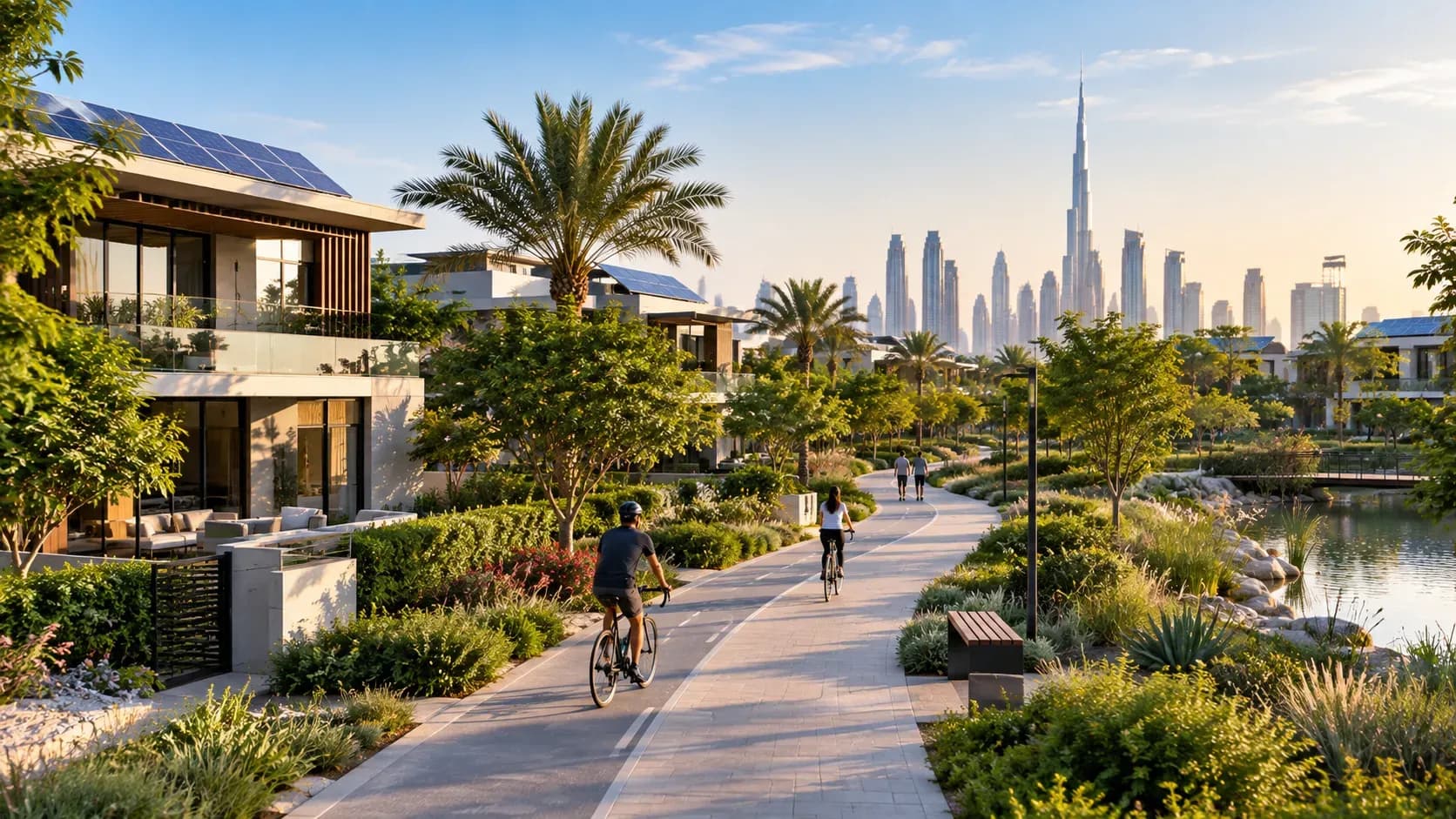
Dubai's property market is increasingly moving beyond traditional considerations such as location, amenities and architectural design. Sustainability is becoming an important part of how new communities are planned and how buyers evaluate long-term residential value.
But a community with plenty of trees and landscaped gardens is not automatically sustainable. A genuinely sustainable community considers how homes use energy, how water is managed, how residents move around, how waste is handled and how the neighbourhood supports quality of life.
Dubai's Urban Plan 2040 also places greater emphasis on sustainability, inclusive development, mixed-use communities and reducing dependence on car-based mobility. The Dubai Land Department has highlighted green buildings, energy performance, low-carbon materials and 15-minute neighbourhood concepts as part of this broader direction.
This guide explains what sustainable communities in Dubai are, the features that define them, the potential benefits for residents and buyers, and some of the communities worth knowing.
Quick Answer
A sustainable community in Dubai is a residential development designed to reduce environmental impact while supporting comfortable, healthy and practical everyday living.
Key characteristics can include:
- Energy-efficient homes and buildings
- Solar energy
- Water-saving and recycling systems
- Green spaces and biodiversity
- Walking and cycling infrastructure
- Electric mobility and EV charging
- Waste reduction and recycling
- Sustainable construction
- Community farming and local food initiatives
- Well-planned public spaces
- Convenient access to essential facilities
The strongest sustainable communities combine several of these elements rather than relying on landscaping alone.
What Is a Sustainable Community?
A sustainable community is a neighbourhood planned around environmental, economic and social considerations.
In property terms, this means sustainability extends beyond the individual home. The infrastructure, public spaces, transportation, landscaping, utilities and community facilities all contribute to the overall environmental performance and quality of life.
For example, a community may use solar panels to generate renewable electricity while also incorporating shaded pedestrian routes, water-efficient landscaping and recycling systems.
The objective is to create a neighbourhood that can use resources more efficiently while remaining comfortable and attractive for residents.
Dubai's sustainability direction increasingly reflects this integrated approach. The Dubai Urban Master Plan 2040 promotes sustainable and inclusive development alongside mixed-use planning and more connected neighbourhoods.
For buyers, this means sustainability should be evaluated at both the property level and community level.
What Makes a Community Sustainable?
Several factors can contribute to a community's sustainability.
Energy Efficiency
Energy efficiency is particularly important in Dubai because cooling can represent a significant part of household energy consumption.
Sustainable developments may use:
- High-performance insulation
- Energy-efficient windows
- Passive design principles
- Efficient cooling systems
- LED lighting
- Smart energy management
- Solar photovoltaic panels
The objective is not simply to produce renewable energy but also to reduce unnecessary energy consumption.
Solar Power
Solar energy is one of the most visible sustainability features in Dubai's residential developments.
Solar panels can be installed on:
- Villa rooftops
- Apartment buildings
- Parking structures
- Community facilities
The Sustainable City is one of Dubai's best-known examples, with solar infrastructure integrated throughout the development. Bayut describes the community as a net-zero energy development with solar panels and car-free zones.
Water Conservation
Water management is another important part of sustainable development in an arid environment.
Sustainable communities may use:
- Low-flow fixtures
- Smart irrigation
- Treated wastewater
- Greywater systems
- Water-efficient landscaping
- Weather-controlled irrigation
The goal is to reduce unnecessary consumption while maintaining usable green spaces.
Green Spaces and Biodiversity
Green areas are important, but sustainability is about how those spaces are designed and maintained.
Well-planned communities may incorporate:
- Native or climate-appropriate plants
- Shaded walking routes
- Community gardens
- Biodomes
- Lakes and water features
- Biodiversity areas
- Landscaped public spaces
Al Barari, for example, places nature at the centre of its residential concept and says more than 60% of its development is dedicated to greenery.
Sustainable Construction
Sustainability can also begin before residents move into a property.
Developers may consider:
- Building orientation
- Insulation
- Low-carbon materials
- Energy-efficient systems
- Natural daylight
- Construction waste
- Long-term building performance
This is increasingly relevant as Dubai's wider planning strategy places greater emphasis on green buildings and energy performance.
Mobility
A sustainable community should also consider how residents travel.
Walking, cycling and public transport can reduce dependence on private vehicles.
Dubai's Super Block initiative, for example, aims to create more pedestrian-friendly zones, increase green and shared public spaces and support sustainable mobility.
This is why walkability can be an important property-buying consideration, particularly for residents who want easier access to community facilities without driving for every short journey.
Waste Management
Waste reduction and recycling can further improve community sustainability.
Potential measures include:
- Recycling stations
- Organic waste management
- Composting
- Waste separation
- Reduced single-use plastics
- Community reuse initiatives
The Sustainable City has developed waste-management systems as part of its broader environmental model. Recent reporting from The National says the community diverts more than 89% of waste from landfill.
Why Is Sustainable Living Becoming More Important in Dubai?
Sustainability is becoming increasingly relevant because Dubai is planning for long-term population growth and urban expansion.
The Dubai Urban Master Plan 2040 is designed around a more sustainable, inclusive and integrated city, with mixed-use communities and reduced dependence on car-based mobility among its objectives.
At the same time, buyers are becoming more aware of:
- Energy consumption
- Utility expenses
- Environmental impact
- Outdoor living
- Wellness
- Walkability
- Community facilities
- Long-term property efficiency
The result is a broader definition of what makes a residential community desirable.
A sustainable community can therefore combine environmental responsibility with practical lifestyle benefits.
Key Features of Sustainable Communities in Dubai
Sustainable communities can vary considerably, but buyers should look for several features together.
Feature | What Buyers Should Look For |
|---|---|
Energy efficiency | Insulation, efficient cooling and lighting |
Solar energy | Rooftop or community solar systems |
Water management | Recycling, efficient irrigation and low-flow fixtures |
Green spaces | Parks, gardens, shaded areas and biodiversity |
Mobility | Walking paths, cycling routes and EV infrastructure |
Waste | Recycling, separation and waste reduction |
Construction | Energy-efficient and environmentally responsible design |
Community planning | Integrated facilities and efficient land use |
The more of these elements that are genuinely integrated into the development, the stronger the sustainability proposition.
What Are the Benefits of Living in a Sustainable Community?
Potentially Lower Resource Consumption
Energy-efficient buildings and water-saving infrastructure can reduce resource consumption.
This does not mean every sustainable development will automatically produce lower household bills. Actual savings depend on the property's design, resident behaviour, utility rates and the systems installed.
However, efficient infrastructure can improve long-term operating performance.
Better Outdoor Environment
Green spaces, shaded pathways and landscaped areas can make outdoor spaces more usable and attractive.
This is particularly valuable in Dubai, where thoughtful landscaping and shade can influence how comfortable residents feel outside.
Health and Wellness
Sustainable communities can encourage healthier lifestyles by making walking, cycling and outdoor recreation easier.
The benefits can extend beyond environmental performance to everyday wellbeing.
Greater Community Interaction
Shared gardens, pedestrian areas, recreational spaces and community facilities can encourage residents to spend more time outside their homes.
The Sustainable City, for example, combines green spaces, urban farming and car-free residential areas as part of its community model.
Long-Term Resilience
Efficient energy, water and mobility systems can help communities become more resilient as environmental and infrastructure requirements evolve.
For buyers planning to hold a property for many years, this can be an important consideration.
Are Sustainable Communities Better for Property Investment?
Sustainability can contribute to a property's appeal, but it should not be treated as a guarantee of higher returns.
For investors, potential advantages include:
- Differentiation from conventional properties
- Growing interest in energy-efficient homes
- Appeal to environmentally conscious tenants
- Potential operating-cost advantages
- Strong lifestyle positioning
- Long-term relevance as sustainability standards evolve
However, investors should still evaluate the fundamentals.
These include:
- Purchase price
- Rental demand
- Rental yield
- Service charges
- Property condition
- Developer reputation
- Community infrastructure
- Location
- Transport connectivity
- Future supply
- Resale demand
A sustainable property can still be a poor investment if it is significantly overpriced or has weak rental demand.
Before comparing sustainable communities, buyers may also benefit from understanding how master-planned communities work and how their infrastructure can influence property demand.
Sustainable Communities in Dubai to Know
Dubai has several communities that incorporate sustainability in different ways. They should not all be considered equivalent or net-zero developments.
The Sustainable City
The Sustainable City is arguably the clearest example of a community designed specifically around sustainability.
Located on Al Qudra Road, it incorporates solar energy, green spaces, urban farming, water recycling, car-free residential clusters and electric mobility. Bayut currently describes it as Dubai's first net-zero energy city.
The community has also continued to attract attention as a working example of integrated sustainable development. The National recently highlighted its combination of renewable energy, water reuse, urban farming, walkable spaces and community-focused planning.
Al Barari
Al Barari takes a different approach by placing nature and biodiversity at the centre of a luxury residential environment.
The community incorporates extensive gardens, lakes, waterways and landscaped areas, with more than 60% of the development dedicated to greenery according to its official website.
Its sustainability proposition is therefore strongly connected to landscaping, biodiversity, wellness and nature-focused living.
Green Community
Green Community in Dubai Investment Park is another example of a residential neighbourhood where landscaping, parks and pedestrian-friendly spaces form an important part of the living environment.
It appeals particularly to buyers looking for established family-oriented surroundings rather than a technology-focused net-zero model.
Tilal Al Ghaf
Tilal Al Ghaf combines residential development with extensive landscaped areas, outdoor recreation and sustainability-focused planning.
The developer states that its masterplan achieved BREEAM Excellent for sustainable placemaking, with an emphasis on energy and water efficiency, responsible construction, high-performance landscapes and waste management.
Dubai Hills Estate
Dubai Hills Estate is not a net-zero community in the same sense as The Sustainable City, but it incorporates large green spaces, parks, walking and cycling infrastructure and integrated community facilities.
It is a useful example of how sustainability can form part of a broader master-planned community rather than being the sole development concept.
Sustainable vs Green Communities: What's the Difference?
The terms "green" and "sustainable" are often used interchangeably, but they can describe different things.
Factor | Sustainable Community | Mainly Green Community |
|---|---|---|
Green spaces | Core consideration | Usually present |
Energy efficiency | Core consideration | May vary |
Solar energy | Often integrated | May be limited |
Water conservation | Important | May vary |
Waste management | Integrated | May be standard |
Walkability | Usually considered | Not necessarily |
EV infrastructure | Often included | May vary |
Sustainable construction | Important | May vary |
Community planning | Holistic | May focus mainly on landscaping |
A green community can be visually attractive because of its parks and landscaping.
A sustainable community generally takes a broader approach that considers energy, water, mobility, waste, construction and social wellbeing together.
How to Choose a Sustainable Community in Dubai
If sustainability is important to your property decision, look beyond marketing terminology.
Check the Energy Systems
Ask whether the property has:
- Solar panels
- Energy-efficient cooling
- Smart energy monitoring
- High-performance insulation
- Energy-efficient appliances
Ask About Water Management
Find out whether the community uses recycled water, greywater systems or smart irrigation.
Also ask how landscaping is maintained during Dubai's hotter months.
Inspect Walkability
Do not assume a community is walkable simply because it has parks.
Check whether you can realistically walk to:
- Shops
- Schools
- Cafés
- Community facilities
- Parks
- Public transport
Check EV Infrastructure
For electric vehicle owners, determine:
- How many charging points are available
- Whether chargers are allocated to individual properties
- Whether additional installation is possible
- What charging fees apply
Review Service Charges
Sustainable infrastructure still requires maintenance.
Before buying, understand the annual service charges and what they cover.
Expensive landscaping, specialist systems and community facilities can influence ongoing costs.
Compare the Property, Not Just the Community
Two homes in the same community can have different energy performance, orientations, layouts, views and operating costs.
Evaluate the individual property alongside the wider community.
Frequently Asked Questions
What is the most sustainable community in Dubai?
The Sustainable City is one of Dubai's strongest examples of a purpose-built sustainable residential community, incorporating solar energy, water recycling, green spaces, urban farming and car-free areas.
Are sustainable homes more expensive in Dubai?
They can be, particularly when advanced energy systems, premium construction and specialised infrastructure are included. However, purchase price varies significantly by location, property type, developer and market conditions.
Do sustainable communities have lower utility bills?
They can have lower resource consumption because of energy-efficient systems and renewable energy, but savings vary by property and household behaviour. Buyers should request actual utility information where available rather than assuming a fixed saving.
Are sustainable communities good for families?
They can be particularly attractive to families because many incorporate parks, walking routes, outdoor recreation, community facilities and quieter residential areas.
Is Al Barari a sustainable community?
Al Barari positions itself as an eco-conscious community focused on nature, wellness and sustainability. Its official website highlights extensive greenery, gardens, water features and biodiversity.
Does sustainability increase property value?
Sustainability can improve a property's differentiation and appeal, but it does not automatically increase value. Location, property quality, purchase price, demand, supply and market conditions remain important.
Key Takeaways
- Sustainable communities consider environmental, economic and social factors together.
- Green landscaping alone does not make a community sustainable.
- Energy efficiency, solar power and water conservation are important considerations.
- Walking, cycling and electric mobility can reduce dependence on private vehicles.
- Sustainable construction and waste management also contribute to overall performance.
- The Sustainable City is one of Dubai's clearest examples of purpose-built sustainable development.
- Al Barari focuses strongly on nature, biodiversity and wellness.
- Tilal Al Ghaf incorporates sustainability into its wider master-planned approach.
- Not every green community is a net-zero development.
- Investors should evaluate sustainability alongside rental demand, pricing, service charges and resale potential.
- Buyers should assess both the community and the individual property before making a decision.
Final Thoughts
Sustainable communities in Dubai are becoming more relevant as the emirate's real estate sector moves toward more efficient, connected and people-focused urban development.
The most important point for buyers is to look beyond labels.
A community with attractive landscaping may offer a pleasant environment, but genuine sustainability involves much more. Energy efficiency, renewable power, water management, mobility, waste reduction, construction quality and community planning all matter.
If you're considering buying property in a sustainable development, compare the actual systems, ongoing costs, location and lifestyle benefits rather than assuming that sustainability automatically means better investment performance.
For buyers researching environmentally conscious property options, Buy Home Dubai can be used as a starting point for comparing Dubai communities and property opportunities.
The right choice ultimately depends on your priorities. For some buyers, energy efficiency and lower resource consumption will be the main considerations. Others may prioritise green spaces, walkability, wellness or long-term investment appeal.
A sustainable community is most valuable when its environmental features also make everyday life more practical, comfortable and resilient.

Dubai Real Estate
Ready to find your
dream home in Dubai?
Browse thousands of properties across Dubai's most sought-after neighbourhoods. Our experts are ready to guide you.